
New

Talk at RCC26 Conference 2026
Talk on "Understanding Structure-Function Relationships through PerformanceDependent Network Evolution" delivered at RCC26.

I develop bio-inspired machine learning systems and physics-informed digital twins for engineering applications — designed to learn fast, generalize well, and run efficiently.
My work spans Liquid State Machines/Reservoir Computing (a biologically-inspired ML paradigm ideal for edge deployment and structural monitoring), optimal network design (how topology shapes learning), and nonlinear dynamics (bifurcation-aware modeling with minimal data).
At TU Berlin, I develop dynamics-informed learning systems for structural mechanics as part of DFG SPP 2353. Previously, I built a theoretical framework for biochemical information processing at the MPI, Bonn — work that now informs my approach to bio-inspired and neuromorphic ML architectures.
I’m interested in 🤝collaborations and roles at the intersection of efficient AI, nature-inspired neuromorphic computing, and physics-constrained learning.
Talk on "Understanding Structure-Function Relationships through PerformanceDependent Network Evolution" delivered at RCC26.

The Reservoir Computing Conference 2026 (RCC26) is an international conference dedicated to the field of reservoir computing and related machine learning approaches. RCC26 …
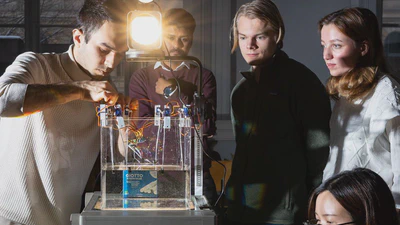
A Berlin University Alliance (BUA) Course for engaging students with hands on research by building a Physical ML device that run on water and helping young scientists lead research …
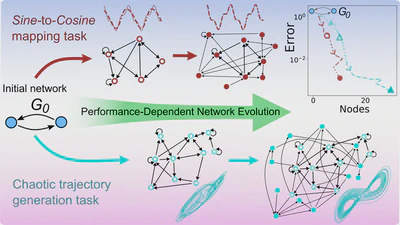
This project has been started to understand emergent structure-function relationship of evolving networks. Part-1: Performance-Dependent Network Evolution (PDNE) framework. I …
PyReCo is a Python based library built by researchers for researchers: we aim to develop new RC methods that allow for fast and efficient learning for sequential data. The main …
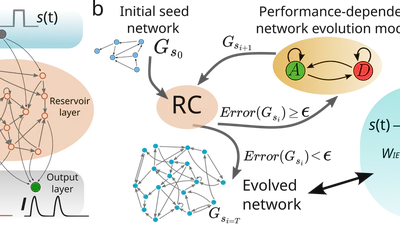
Performance-dependent network evolution is applied to Wilson-Cowan neuronal dynamics, revealing compact reservoirs that generalize well and recover interpretable …
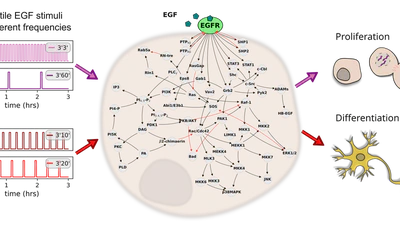
Study of homeorhetic regulation mechanisms in cellular phenotype dynamics.
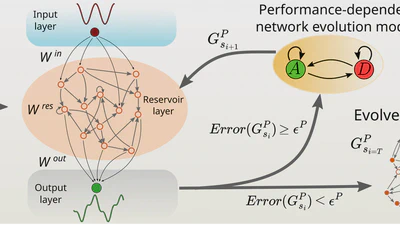
Can evolution beat random chances? Our answer: Yes, we have a proof! 😃
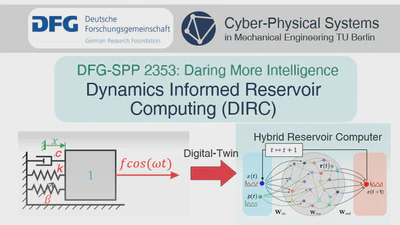
This study uses a data-driven approach to investigate how bifurcations can be learned from a few system response measurements.
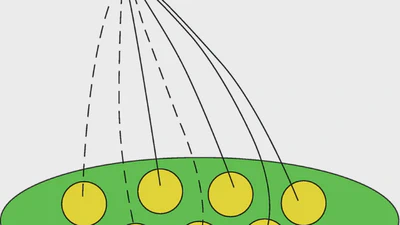
We explore the effect of a common external system, which may be considered as a common environment, on the oscillation death(OD) states of a group of Stuart–Landau(SL) oscillators. …
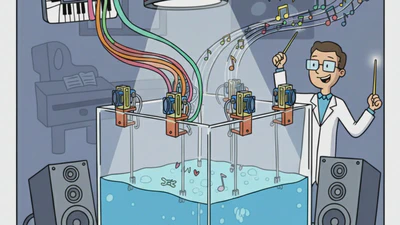
Project Planning The next phase of of the project of information processing with bucket of water based Physcial Reservoir Computers is being planned to generate music with it. …