Research Featured in TU Berlin Annual Magazine Wir/Vier 2024
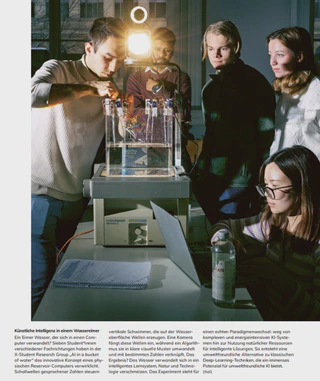 Cover feature in TU Berlin Annual Magazine Wir/Vier 2024 - Physical Reservoir Computing
Student Reasearch Group 2024 on Physical Reservoir Computing featured prominently on the cover of TU Berlin’s prestigious Annual Magazine Wir/Vier 2024, showcasing the innovative “AI in a Bucket of Water” project.
Revolutionary AI Computing with Water
The TU Berlin Annual Magazine Wir/Vier 2024 featured our groundbreaking Physical Reservoir Computing project as its cover story, highlighting the revolutionary approach to artificial intelligence that uses the natural dynamics of water as a computational system. This unprecedented recognition brings international attention to TU Berlin’s innovative research in sustainable AI technologies.
The Physical Reservoir Computing Project
Project Overview
The “Physical Reservoir Computing: AI in a Bucket of Water” project, funded by the Berlin University Alliance (BUA), represents a paradigm shift in machine learning approaches. Instead of traditional digital neural networks, this innovative system harnesses the natural dynamics of water ripples to perform complex computations.
How It Works
- Physical Reservoir: Water surface acts as the computational medium
- Input Mechanism: Small disturbances create ripples on the water surface
- Data Capture: High-speed cameras record the evolving ripple patterns
- Processing: Linear readout systems process the captured dynamics
- Output: Complex pattern recognition and machine learning tasks are solved
Key Innovation
This approach creates an energy-efficient and nature-inspired machine learning system that serves as a demonstrator for sustainable AI. The water-based system offers a fundamentally different computational paradigm compared to energy-intensive traditional AI systems.
Research Leadership & Team Structure
Young Group Leader Excellence
As the project’s Young Group Leader, Dr. Manish Yadav designed and led this interdisciplinary research initiative that connects:
- Machine Learning algorithms and theory
- Physics of fluid dynamics and wave propagation
- Engineering hardware and control systems
Scientific Impact & Innovation
Sustainable AI Computing
The research addresses critical challenges in modern AI:
- Energy Efficiency: Dramatically reduced computational energy requirements
- Natural Computing: Leveraging physical processes for information processing
- Scalability: Potential for large-scale sustainable AI implementations
Educational Impact
The project serves multiple educational purposes:
- Research Training: Students gain experience in experimental design, data analysis, and scientific communication
- Leadership Development: Opportunities for young scientists to lead research teams
- Innovation Mindset: Encouraging unconventional approaches to complex problems
Technical Details & Research Links
Project Resources
- Wir/Vier 2024 Magazine: “X steht für Exzellenz” - TU Berlin in der BUA
- BUA Conference Presentation 2024: Session A1.2 - Physical Reservoir Computing
- LinkedIn Discussion: BUA Call for Proposals - STUROP-X Project
- Complete Project Details: AI in Bucket of Water - Physical Reservoir Computer
- TU Berlin Course Page: CPS-ME X-Student Research Group
- BUA Research Groups: Berlin University Alliance
- Research Group: Cyber-Physical Systems in Mechanical Engineering, TU Berlin
Broader Impact
This research contributes to:
- Sustainable Computing: Alternative approaches to energy-intensive AI systems
- Bio-Inspired Technology: Learning from natural information processing systems
- Educational Innovation: New paradigms for hands-on STEM education
This research exemplifies TU Berlin’s commitment to innovative, sustainable technology development and demonstrates the university’s leadership in next-generation computing approaches. The magazine feature in Wir/Vier 2024 celebrates not only technical innovation but also the collaborative spirit that drives cutting-edge scientific discovery.
