Research Featured in AIP Scilight: Optimizing Reservoir Computing for Noisy Nonlinear Systems
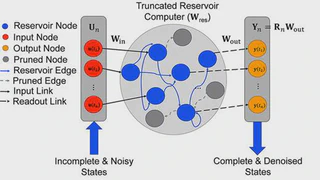 AIP Scilight Feature - Reservoir Computing for Nonlinear Systems
Research on optimizing reservoir computing for studying noisy nonlinear systems has been featured in AIP Scilight, highlighting innovative approaches to signal processing and denoising applications.
AIP Scilight Recognition
The prestigious AIP Scilight has featured cutting-edge research on “Optimizing reservoir computing to study nonlinear systems”, showcasing a breakthrough approach to signal processing and denoising in complex dynamical systems.
Research Innovation
The Challenge
Many systems in nature are nonlinear — changes in input aren’t proportional to output changes. Scientists need to predict these complex systems (like neuron firing) but face the challenge of reconstructing hidden states from limited, noisy measurements without knowing the underlying physics equations.
The Solution
Sedehi, Yadav et al. present a revolutionary truncated reservoir computing approach that:
- Distinguishes noise from signal without physics-based models
- Reconstructs nonlinear dynamics from incomplete, noisy data
- Enhances efficiency through intelligent node and edge pruning
- Optimizes performance with novel machine learning protocols
Breakthrough Results
Testing on two nonlinear systems (Lorenz attractor and biological neuron models), the approach competes with conventional filtering techniques at low signal-to-noise ratios and high-frequency ranges.
Research Resources
- AIP Scilight Feature: Optimizing reservoir computing to study nonlinear systems
- Article Page: Denoising with Pruned RC
- Research Groups: Cyber-Physical Systems in Mechanical Engineering, TU Berlin and Uni. of Sydney, Australia.
