Information Processing with Transients
 Manish Yadav, PhD Thesis
Developing a theoretical framework to explain biochemical information processing in living cells through transient dynamics - the foundation of cellular computation and real-time biological decision making.
Project Overview
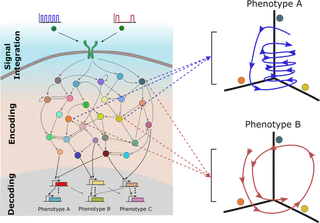
This research project, conducted as part of my PhD thesis at the Max Planck Institute for Neurobiology of Behavior - caesar, explores how living cells process information through transient dynamics in biochemical networks. Rather than focusing on steady states, this work reveals how transient responses serve as the fundamental computational units in biological systems.
Theoretical Foundation
Core Concept: Transients as Information Carriers
The central hypothesis is that transient dynamics - the temporary responses of biochemical networks to stimuli - carry more information than previously recognized and serve as the primary mechanism for cellular computation.
Key Research Questions
- How do biochemical networks encode and process information through transient responses?
- What computational capabilities emerge from transient dynamics in cellular systems?
- How can we develop mathematical frameworks to quantify information processing in biochemical networks?
Research Methodology
Theoretical Development
- Mathematical Modeling: Development of novel theoretical frameworks for transient-based information processing
- Network Analysis: Investigation of biochemical network topologies that optimize information processing
- Information Theory: Application of information-theoretic measures to quantify computational capacity
- Evolutionay Analysis: Analyzed protein interation networks of 14 different species to identify which parts of networks are conserved over the evolution.
Biological Applications
- Cellular Signaling: Analysis of how cells use transients for decision-making processes
- Real-time Processing: Understanding how cells achieve rapid responses through transient dynamics
- Adaptive Behavior: Exploration of how transient-based computation enables cellular adaptation
Key Contributions
Novel Theoretical Framework
Development of a comprehensive theory explaining how:
- Transient responses with metastable states encode information more efficiently than steady-state dynamics
- Network topology influences information processing capabilities
- Real-time computation emerges from transient biochemical dynamics
Biological Insights
- Demonstration that cells utilize transient dynamics for rapid information processing
- Identification of network motifs that optimize transient-based computation
- Understanding of how biochemical noise affects information transmission
Research Impact
Scientific Significance
This work bridges systems biology and information theory, providing new perspectives on:
- How biological systems perform computation without traditional digital components
- The role of dynamics (rather than steady states) in biological information processing
- Novel computational paradigms inspired by biological systems
Broader Applications
The theoretical insights have implications for:
- Synthetic Biology: Design of artificial biochemical networks with enhanced computational capabilities
- Bio-inspired Computing: Development of new computational architectures based on transient dynamics
Related Work
PhD Thesis Context
This project formed the core of my PhD dissertation on “Theory of real-time biochemical computations with transients,” supervised by Dr. Aneta Koseska at MPI-NB caesar, Bonn.
Publication Outcomes
The research has resulted in several publications, including work on homeorhetic regulation, demonstrating the practical applications of transient-based information processing in biological systems.
Technological Applications
- Translation of biological computation principles to artificial systems
- Development of bio-inspired algorithms for real-time processing
- Integration with current work on physical reservoir computing
Research Environment
Institution: Max Planck Institute for Neurobiology of Behavior - caesar, Bonn
Research Group: Cellular computations and learning (Dr. Aneta Koseska)
Duration: 2019-2023
Degree: PhD in Biophysics (Complex Networks and Dynamical Systems focus)
This project represents fundamental research into how life itself performs computation, revealing the sophisticated information processing capabilities that emerge from the dynamic nature of biochemical networks. The insights gained continue to influence current research in physical computing systems and bio-inspired machine learning approaches.
